OFF-GRID LIVING / START HERE
How to Build an Off-Grid Solar System
You can leave the utility connection behind and still keep the lights, laptop and refrigerator running. Start by figuring out what your version of off-grid life actually needs.
Start with your power needs · See a cabin example · Plan your equipment
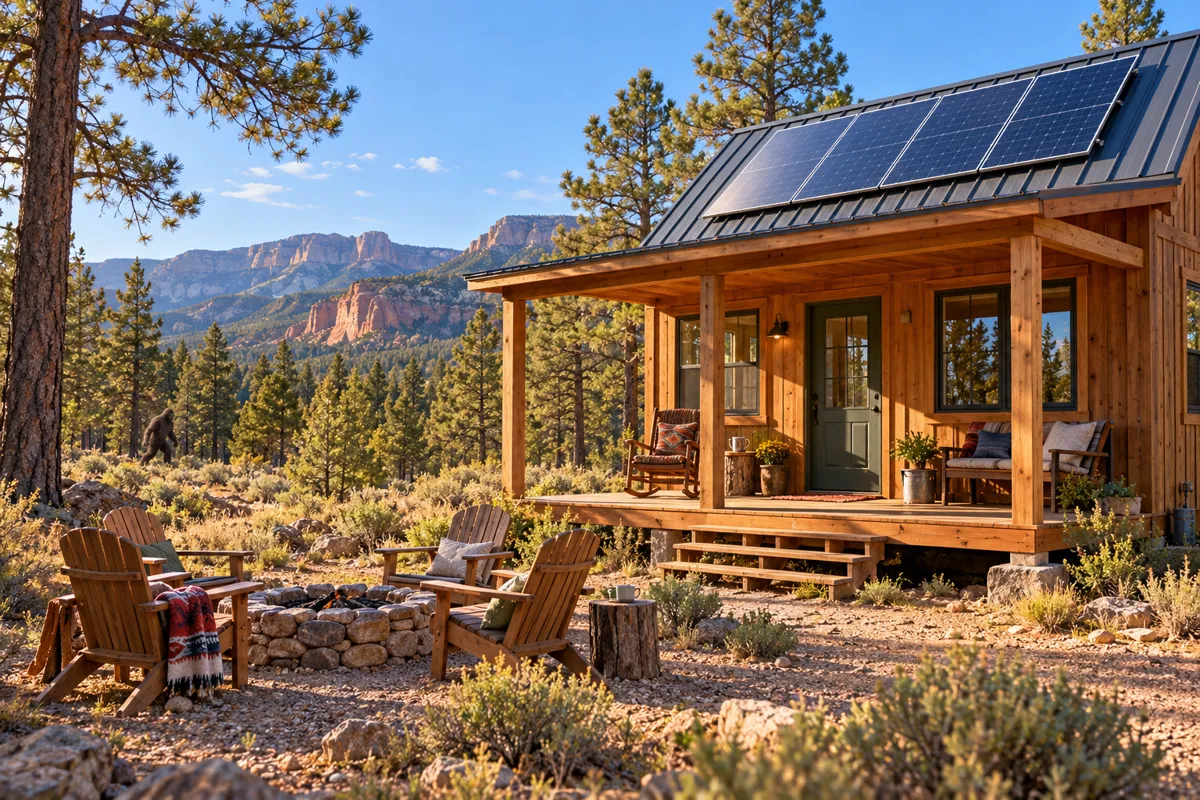
Bigfoot has the privacy part figured out. The rest of us would probably like a working refrigerator and an internet connection. That is where an off-grid solar plan earns its keep: matching the things you want to use with the energy you can produce, store and replenish.
The first purchase should follow the plan. A panel bundle that looks like a bargain can become expensive if it needs a different controller, more storage or an inverter that can start your pump. Work through the loads and the location before choosing equipment.
1. Describe the life you want to power
A weekend cabin and a full-time home are different jobs. Write down when the building will be occupied, which appliances must keep running while you are away, and what happens if the battery gets low. Electric heating, hot water and air conditioning deserve their own discussion because they can change the scale of the project.
Measure plug-in appliances over a representative period where possible. Refrigerators cycle; a label does not tell you their exact daily consumption. Pumps and compressors also have startup demands that a daily energy total will not reveal.
2. Make a daily energy budget
For a steady load, watts multiplied by operating hours gives watt-hours. Divide by 1,000 for kilowatt-hours. Keep daily energy separate from instantaneous power: a small load running all day can use more energy than a larger load used briefly. The U.S. Energy Information Administration explains these units.
A small cabin example you can adjust
These are invented planning inputs, not measured appliance specifications. Replace them with your own readings. This example excludes cooking, space conditioning, water heating, refrigeration and pumps.
| Load | Assumed watts | Hours/day | Energy/day |
|---|---|---|---|
| Laptop | 60 | 5 | 300 Wh |
| Internet equipment | 25 | 8 | 200 Wh |
| Combined lighting | 20 | 5 | 100 Wh |
| Fan | 30 | 6 | 180 Wh |
| Illustrative appliance total | 780 Wh/day | ||
Two days of those loads require 1,560 Wh delivered to the appliances. That is a starting energy requirement, not a battery recommendation. Conversion losses, equipment idle consumption, allowable discharge, temperature and reserve all affect the rated storage needed. The inverter must also handle the combination of loads you actually run together.
3. Plan around the difficult season
Use the property’s location, shade, mounting position and intended months of use when evaluating production. Hours of daylight are not equivalent to full-power solar hours. A summer estimate is a poor basis for a cabin used through winter.
The array needs to support ordinary use and recover storage after low-production periods. Ask the designer what happens after several cloudy days, how quickly the batteries recover, and which loads you would need to postpone. Australia’s government solar design guidance discusses the role of storage in stand-alone systems.
Follow the energy through the system
In a typical battery-based system, panels supply DC power through charging equipment to storage. An inverter supplies AC appliances from the battery system. Suitable DC loads can have a separate regulated supply.
Conceptual overview only. Protective devices, grounding, distribution, regulated DC branches and backup charging are omitted. Integrated equipment may combine several functions. This is not an installation schematic.
4. Choose the system architecture
A portable power station with compatible panels can suit a limited set of plug-in loads. A fixed cabin system gives you different expansion and distribution options, but involves more separate components and installation decisions. Compare them against the same load budget, recharge needs and expected service life.
5. Check the whole equipment list
- Panels, mounting and weather-appropriate cable routing.
- Charge controller or integrated solar input matched to the array.
- Batteries, appropriate charging settings and permitted operating temperatures.
- Inverter output, startup capability and compatible battery voltage.
- Correctly specified wiring, overcurrent protection, disconnects and grounding.
- Monitoring, maintenance access and a backup charging plan.
Connector shape alone does not establish compatibility. Before buying, compare the manuals and electrical limits for every component, including array voltage at the design temperature. Have a qualified installer handle fixed wiring and confirm the applicable local requirements. This is a planning guide, not a wiring diagram.
Start shopping with your requirements in hand
Our BLUETTI collection covers portable power and storage options. Read the individual guides to check included equipment and limitations. A collection listing is not a claim that every product can power a whole cabin.
Can I build it in stages?
Yes, when the original design allows it. Ask which batteries, panels and charging equipment can be expanded together before assuming a later addition will fit.
Does off-grid mean I never need backup?
That depends on the loads, location and design. Decide how much interruption you can accept, then plan storage, load reduction and backup charging around that requirement.
AZSP guide • October 31, 2026. Examples are explicitly hypothetical. Product links lead to AZSP guides; relevant merchant links on those pages may earn us a commission.
Taking work with you? Read our cabin office power guide.