THE SHORT ANSWER
Panels generate electricity, batteries store it, and power electronics manage charging and supply usable outputs. The components you need depend on what you want to power and how the system is connected.
Follow the electricity, not the marketing name
Photovoltaic cells convert sunlight into electricity. Cells are combined into panels; several panels can form an array. The Department of Energy explains that panels are one part of a complete photovoltaic system, alongside mounting and equipment that handles the electricity. DOE technology overview.
For shopping, the important question is what happens after the panel. A panel on its own is not necessarily a complete charger for your device. Identify the receiving equipment and the output the device needs before deciding what to buy.
Three common setups, three different shopping lists
| Application | What to identify | What buyers can miss |
|---|---|---|
| Portable device charging | Compatible panel, charging device or power station, and cables | Whether storage and the required output port are included |
| RV or off-grid battery system | Panels, controller, battery, power outputs, wiring and mounting | Existing-system compatibility and installation parts |
| Grid-connected home | Generation equipment, inverter, roof or mounting scope, utility connection | Backup operation is a separate configuration question |
A power station can package several functions inside one case. A component-based system separates them. Compare complete working configurations rather than counting boxes or assuming one architecture is automatically cheaper.
EXPLORE RELEVANT EQUIPMENT
Put your plan to work.
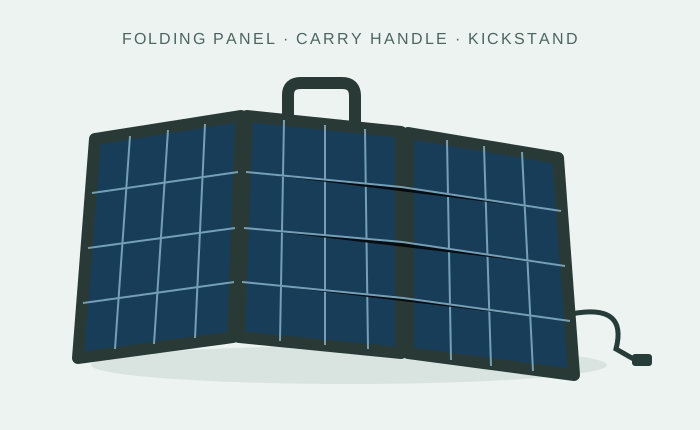
Portable solar panels
Explore category →
Batteries & storage
Explore category →Solar kits
Explore category →Category illustrations, not tested product recommendations. Verified products and merchant offers will be added as the catalog develops.
Generation is different from storage
A panel produces power under suitable light conditions. A battery holds energy for later. Adding panel capacity and adding battery capacity address different constraints: one concerns replenishment, the other concerns stored energy.
If your devices run mainly after sunset, ask how their energy use will be stored and replenished. If you will move camp each day, ask when the panel can actually be deployed. A larger battery can postpone recharging, but it cannot create the energy needed for repeated use.
DC, AC, and the device at the end
Panel and battery specifications commonly refer to DC. Household outlets commonly supply AC. An inverter provides AC from a suitable DC source. Some devices can use a supported DC or USB output instead; verify the exact port and device requirements.
Do not buy an inverter just because the system contains a panel, or assume a USB port supports every laptop. Trace the intended connection all the way to the device. Check the specifications and the manual for each step.
A simple planning example
Suppose your camping equipment uses a steady 50 W for four hours. It needs 200 Wh delivered to those devices. That describes energy use, not a panel rating and not a verified battery runtime. Losses, reserve, and recharge conditions still need to be allowed for.
Start with the load list, establish the required output, then estimate storage and a realistic recharge plan. Our energy calculator lets you change those assumptions. Its arithmetic is a planning aid, not a weather model or electrical design.
Choose the next question to answer
For a phone or laptop, continue to solar chargers. For stored portable power, compare solar generators. For installed equipment, read inverters and batteries and identify the design and installation support you need.
AZSP’s approach is to understand the job first, then compare the equipment that can do it. A component’s impressive specification is useful only when it helps the complete setup meet your needs.
Sources & further reading
Reviewed October 22, 2026. The examples are planning illustrations, not results from product testing. Manufacturer instructions apply to the specified equipment.