THE SHORT ANSWER
Start with device watts and hours of use. The tool below calculates energy demand and an illustrative storage target. It does not calculate a roof design, utility-bill savings, or an installer quote.
Estimate your energy needs
Use a measured average load where possible. For cycling equipment, enter its average demand over the selected period or use measured watt-hours separately. A device’s maximum label rating may not represent normal consumption. The calculator starts with an example you can change.
Plan a small power setup
Illustrative assumptions only. No location or weather model is applied.
EXPLORE THE PRODUCT FAMILIES
Find your next starting point.
Batteries & storage
Storage for a compatible system.
Explore category →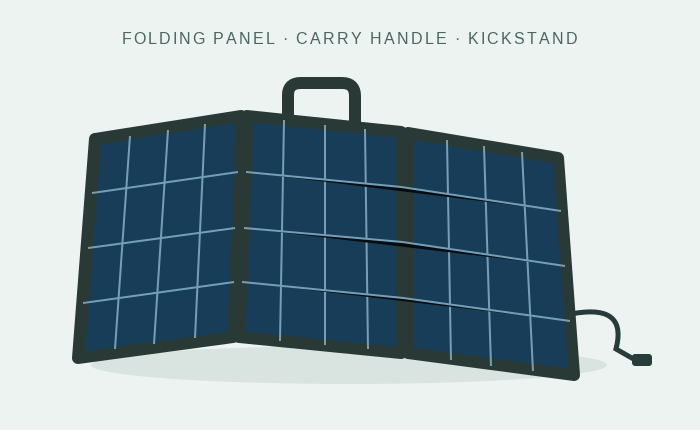
Portable solar panels
Charging you can take outdoors.
Explore category →
Portable power stations
Integrated, movable power.
Explore category →Category illustrations. Individual products and merchant offers will be added as the catalog develops.
Understand the assumptions
Delivered energy equals average watts multiplied by hours. The storage estimate divides that energy by the assumed delivery efficiency and the usable fraction remaining after your selected reserve. Reserve here means a share of the battery energy left unused, not a separate percentage added to the load.
A panel estimate divides the energy to replenish by your assumed equivalent full-sun hours and an overall charging-yield factor. That factor must account for the losses and conditions you intend to model. These are simplified planning relationships, not verified performance for a particular product.
Rooftop production needs a different tool
PVWatts estimates production for grid-connected photovoltaic systems using location and system inputs. Use it for a generation estimate, then examine the layout, shading, and assumptions with your installer. It does not turn our small-load calculation into a complete home design. Open PVWatts.
Energy produced is not automatically money saved. A savings analysis also needs your tariff, the timing of consumption, export treatment, system cost, and financing. Keep these separate from the physical energy calculation.
Use the result to ask better questions
Check that the chosen battery’s output can support your loads as well as its capacity. Check the solar input limits and whether the required panels fit the space and charging conditions. For refrigerators and other cycling appliances, validate a complete operating period instead of assuming a fixed continuous draw.
The calculation runs in your browser and asks for no contact details. It sends no installation inquiry. Continue to battery guidance or panel selection before choosing equipment.
Sources & further reading
Reviewed October 22, 2026. Manufacturer references describe their equipment; they do not establish compatibility for another product.