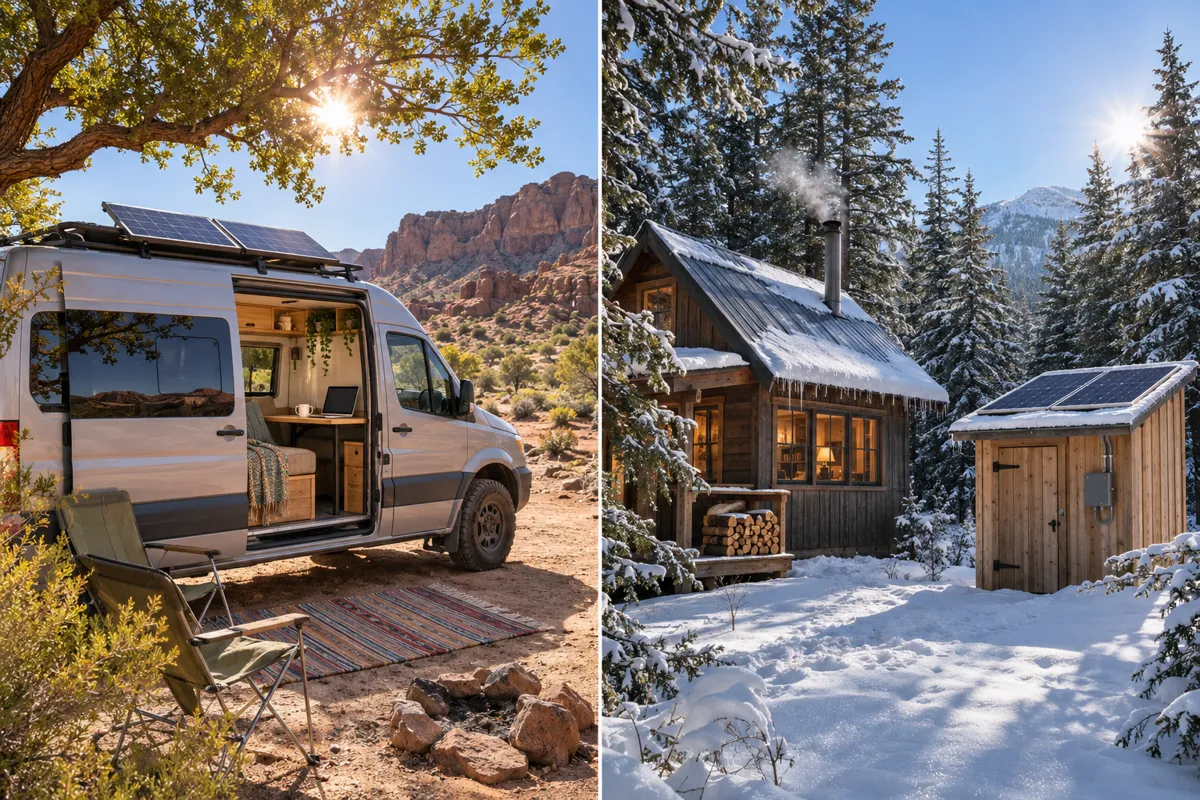
The campsite can be beautiful and the battery compartment can still be freezing. That is the decision behind these two DEKA Duration models. Before paying for a heater, think about where the battery sits when charging begins.
Which conditions match your plans?
| Your situation | Model to investigate | Check before buying |
|---|---|---|
| Battery stays within the standard charging range | DD100-12 | Measure conditions at the battery, including unattended periods. |
| Charging may begin below freezing | DD100-12H | Follow the heating procedure and confirm the charging source can support it. |
| You need longer runtime | Size the battery bank first | Both listings are 100Ah. A heater does not add storage capacity. |
| You need to run a pump or inverter | Neither model is selected by capacity alone | Verify continuous current, startup demand and charger compatibility. |
What changes between them?
| Detail | DD100-12 | DD100-12H |
|---|---|---|
| Listed battery capacity | 100Ah | 100Ah |
| Voltage class | 12V | 12V |
| Chemistry | LiFePO₄ | LiFePO₄ |
| Built-in heating | No | Yes |
| Manufacturer-listed charging range | 32°F to 140°F (0°C to 60°C) | −4°F to 140°F (−20°C to 60°C), subject to the heating procedure |
| Discharging temperature | −4°F to 140°F (−20°C to 60°C) | −4°F to 140°F (−20°C to 60°C) |
| Shopping link | Check DD100-12 at A1 SolarStore | Check DD100-12H at A1 SolarStore |
AZSP may earn a commission if you purchase through these links. Current price, availability, shipping and order quantity are shown by A1 SolarStore.
Choose for the compartment, not the ZIP code
A battery inside a temperature-controlled space faces a different job from one in an unheated RV compartment. Your home may be in Phoenix while your next trip is in the mountains. Think about the temperature around the battery on the coldest morning of that trip, especially when solar charging resumes.
Standard model scenario
You use the system in mild weather and can keep the battery within its documented charging limits. Compare the standard model first, then verify the rest of the installation.
Heated model scenario
You expect charging in an unheated compartment during cold trips. Investigate the heated model, including how its heater interacts with your charging source.
The heater needs a charging plan too
The manufacturer describes a heating sequence before normal charging under cold conditions. Read that procedure alongside the specifications for your charger or controller. Do not assume that the appearance of sunshine means charging energy immediately goes into storage.
That is particularly relevant to a small array with a short winter charging window. Ask how much incoming power is needed for the heating process and how long warming may take in your installation. We have not measured either model's heater consumption or warm-up time.
Capacity does not answer every question
A larger heater budget is not a larger battery. The comparison still needs your daily energy use, discharge requirements, compatible charging equipment and physical installation. Check exact dimensions, terminals and clearance against the current documentation before ordering.
A useful runtime example begins with delivered energy rather than an advertised category label. If a system delivers an assumed 900Wh to a steady 60W load, the arithmetic is 15 hours. That is an original hypothetical example, not a measured result for either DEKA model.
What would make us choose one over the other?
We would start with the standard model for a demonstrably mild charging environment. We would investigate the heated version for an installation expected to recharge below freezing. We would not claim the heated model solves every winter-power problem: storage, incoming solar energy and operating limits still matter.
Does the heated version power appliances for longer?
It has the same listed amp-hour capacity. Actual runtime depends on delivered energy, loads and conditions. Heating does not create extra stored energy.
Can either battery replace a BLUETTI expansion pack?
Do not assume so. A standalone battery and a manufacturer's expansion pack have different connection and control requirements. Only use combinations explicitly supported by the relevant equipment manufacturers.
Explore each battery
DEKA DD100-12 buying guide · DEKA DD100-12H buying guide
Keep planning
Size your battery bank · Plan RV solar · Plan for poor solar weather
Sources: MK Battery Deka Duration installation and user manual; the two A1 SolarStore listings linked above. Research-based comparison, not a hands-on test. Check the current manufacturer instructions for the exact model before installation.