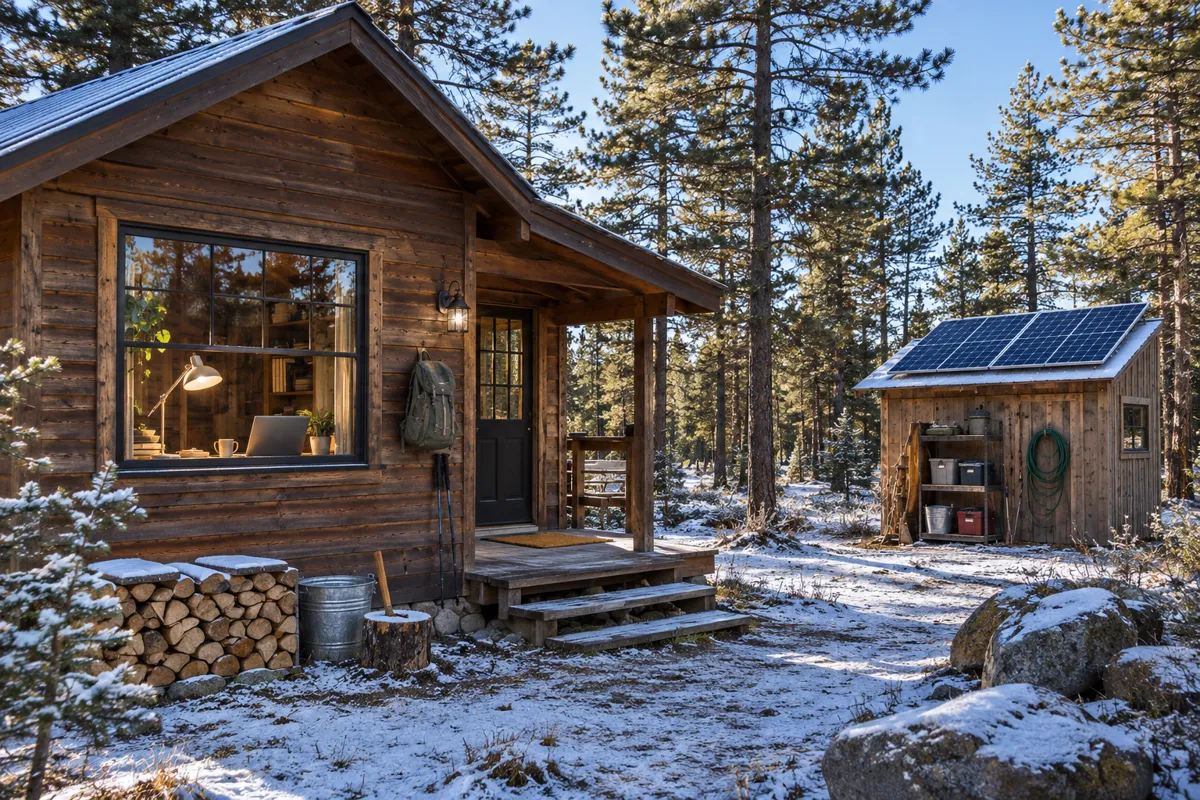
The short answer: A few lights and a laptop need a different solar plan from a workshop with a saw, heater or well pump. Start with a daily energy budget, then compare a portable setup with a fixed system.
Example: a weekend cabin work corner
You arrive Friday evening, turn on the lights and open the laptop. The panel has stopped producing for the day. What matters now is stored energy—and whether the system can replace it tomorrow.
This invented example covers a small work corner in a shed or cabin. It excludes refrigeration, cooking, heating, pumps and power tools. Replace every assumption with measurements from your equipment.
| Load | Assumed draw | Daily use | Energy |
|---|---|---|---|
| LED lights | 20W total | 4 hours | 80Wh |
| Laptop | 60W average | 4 hours | 240Wh |
| Router | 10W | 8 hours | 80Wh |
| Phone charging | Daily allowance | — | 20Wh |
| Example total | 420Wh/day | ||
At an assumed 85% overall delivery efficiency, that is about 494Wh withdrawn from storage: 420 ÷ 0.85. Two days would require about 988Wh before adding reserve, standby draw or temperature effects. This is a planning calculation, not a runtime claim for a particular battery.
Choose the installation before the panel
Portable power
For occasional visits, investigate a power station and its supported portable panel. Check input voltage, current, connector and output limits. Being able to pack the equipment away may matter more than permanent mounting.
Explore our BLUETTI guides →Fixed equipment
For regular use, compare a designed panel, controller, battery and inverter system. Add mounting, protection, wiring and qualified installation support to the budget.
Check the charging and power path →A1 SolarStore products to investigate
These are separate purchasing candidates. They are not a verified matched kit, and neither panel has been approved here for direct connection to the DEKA battery.
| Candidate | Role | What must be resolved |
|---|---|---|
| Mission Solar MSX10-435HN0B, 435W | Fixed solar collection | Dimensions, mounting, controller input limits and cold-weather open-circuit voltage. |
| Hyundai HiN-T440NF(BK), 440W | Alternative fixed panel | Exact model, electrical ratings and fit; do not assume extra rear-side production. |
| DEKA DD100-12 | 100Ah, 12V-class storage candidate | Usable energy, discharge limits, charging settings and installation environment. |
| DEKA DD100-12H | Heated storage alternative | Cold charging conditions and the manufacturer's heating procedure. |
A1 SolarStore links include affiliate tracking. AZSP may earn a commission from qualifying purchases. Check current availability, order minimums and delivery charges.
What one panel might collect
Using the Mission panel's 435W rating, an invented scenario of four peak-sun-hours and a 75% collection factor gives 1,305Wh/day: 435 × 4 × 0.75. That factor represents assumed aggregate collection losses; it is not a measured result. Peak-sun-hours are equivalent full-power hours, not simply hours of daylight.
How much of that energy reaches the battery depends on where losses occur and what else is running while you charge. Shade, winter sun and cloudy days can change the result. Use site-specific production estimates and plan how you’ll recharge after poor weather.
The parts still missing
- A compatible charge controller and manufacturer-approved settings.
- An inverter if AC loads require one, sized for continuous and starting loads.
- Specified wiring, terminations, disconnects, overcurrent protection and grounding.
- Mounting and a suitable battery location, with structural and weather checks.
- A complete design, any required permits, installation labor and commissioning.
When to request a complete-system quote
A1 also advertises 2kW roof-mounted and ground-mounted off-grid systems with batteries. Those are quote-based configurations. Ask for exact panel, inverter and battery models, storage capacity, included protection, mounting parts, exclusions and delivered cost before comparing them with this smaller example.
A 2kW array rating does not tell you battery runtime or inverter output. A quote sized for a cabin with refrigeration or a pump may be very different from the work-corner example above.
Explore A1 off-grid system quotes →
Before you buy
Write down daily watt-hours, maximum simultaneous watts, starting loads, days of reserve and expected charging conditions. Then request one itemized plan that connects all of those requirements. For a permanently wired building, resolve applicable electrical and structural requirements with qualified help.
Continue with our DIY kit buying guide and cloudy-weather energy example.
Research reviewed November 3, 2026. Sources: A1 SolarStore's linked Mission Solar and Hyundai listings, DEKA listings linked from our product guides, and off-grid system category. Calculations are invented educational examples. AZSP has not installed or tested this combination.