The short answer: Choose an RV battery upgrade by checking the RV's charging equipment, loads and battery compartment first. A battery that fits the tray can still require changes elsewhere in the system.
Start with what runs out first
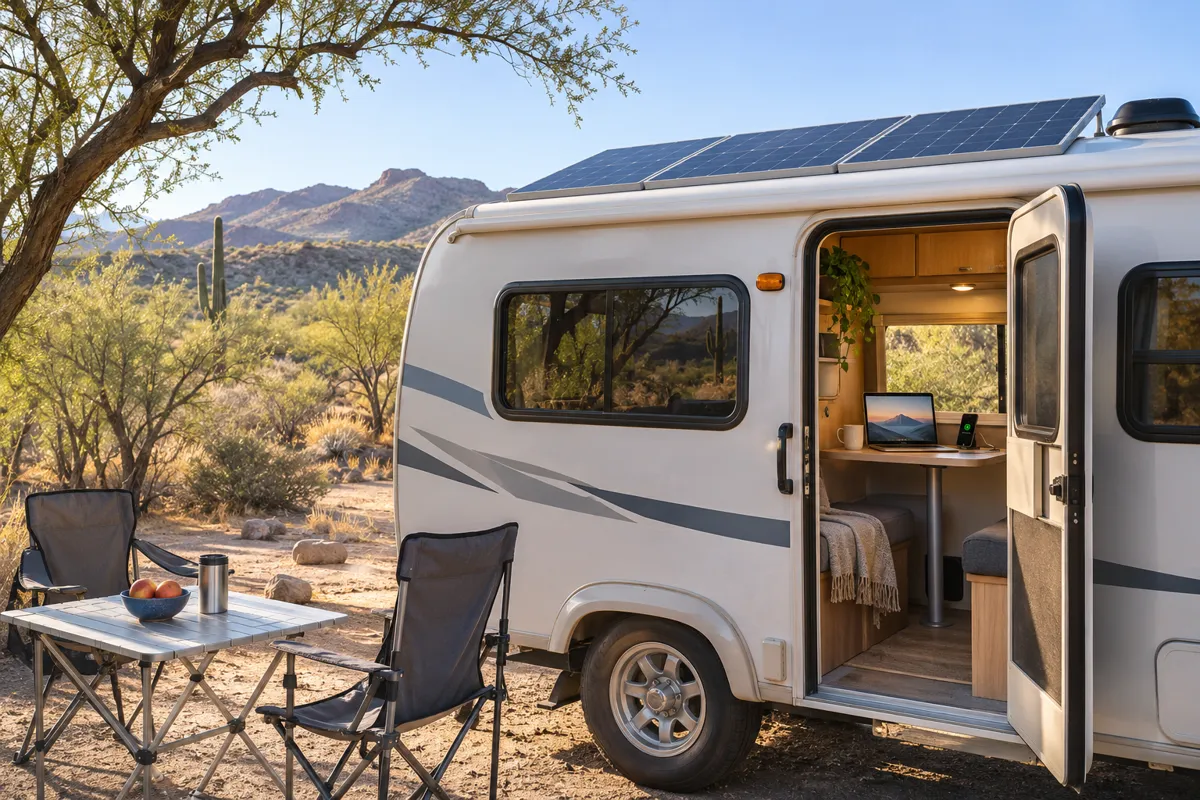
Picture an evening without hookups: the lights are on, the water pump cycles and a laptop is charging. If storage runs out before morning, more usable energy may help. If an appliance cannot start, the limit may be current, inverter output or wiring instead. If the battery never recovers during the day, investigate charging before adding storage.
This guide considers an RV house-battery project. It does not recommend replacing an engine starting battery, and it is not a vehicle-specific installation procedure.
Example overnight energy budget
| Load | Assumption | Energy |
|---|---|---|
| Lights | 18W × 4 hours | 72Wh |
| Ventilation fan | 15W × 8 hours | 120Wh |
| Water pump | 60W × 0.2 hours total | 12Wh |
| Laptop | 60W × 2 hours | 120Wh |
| Phone and small electronics | Daily allowance | 30Wh |
| Example appliance total | 354Wh | |
At an assumed 85% overall delivery efficiency, the example draws about 416Wh from storage: 354 ÷ 0.85. For two nights, (2 × 354 Wh) ÷ 0.85 ≈ 833 Wh from storage, before reserve, idle loads or temperature effects. Before ordering, write down the model numbers of your shore-power charger, solar controller and alternator charger, if fitted. Check each against the battery maker’s charging instructions. Refrigerator use, furnace fans, medical equipment, entertainment and other loads are excluded; add them if present.
At a nominal 12V, 100Ah corresponds to 1,200Wh by simple multiplication. Actual usable energy depends on the exact battery, permitted operating range and system losses. Do not treat the advertised amp-hour rating as a delivered AC runtime guarantee.
Two DEKA candidates already covered on AZSP
DEKA DD100-12
A 100Ah, 12V-class LiFePO₄ candidate to investigate when the installation can keep charging within the manufacturer's permitted conditions.
Read the standard battery guide →DEKA DD100-12H
A heated alternative in the same listed capacity class. Investigate it when cold charging conditions are part of the trip; follow the exact heating procedure.
Read the heated battery guide →The heated model is not an automatic capacity upgrade. Compare the two DEKA versions around the coldest expected battery conditions, including storage and unattended periods.
Audit every charging source
| Charging source | Record before buying | Decision to resolve |
|---|---|---|
| Shore-power converter/charger | Exact model, supported chemistry, charging stages and settings | Does the manufacturer support the selected battery and required settings? |
| Solar controller | Model, battery profiles, output current, temperature features | Can it charge the battery as specified under the expected conditions? |
| Tow vehicle or alternator | Existing charging path, isolation, current control and wiring | Is a suitable DC-to-DC charging arrangement required? |
| External charger or generator-fed charger | Actual charger model and output settings | Is it approved for the battery, including cold-weather operation? |
A “lithium” menu option alone does not establish compatibility. Compare the charger's actual behavior with the battery documentation. Ask an RV electrical specialist to resolve an undocumented converter or alternator charging path before purchasing.
Check fit and discharge demand
- Measure the compartment, terminal clearance, cable reach and secure mounting space.
- Check maximum simultaneous DC demand and inverter starting loads against battery limits.
- Have cable sizing, connections, disconnects and overcurrent protection reviewed for the planned system.
- Confirm environmental limits and temperature protection for every charging source.
- Check permitted battery combinations before expanding; do not assume an old battery can remain in parallel.
A 12V-class label does not establish that an existing battery monitor will report state of charge correctly. Review its supported chemistry, calibration and installation requirements too.
What belongs in the upgrade budget
The battery is one line item. Allow for any converter or charging changes, monitoring, mounting, wiring, protection, labor and delivery. Obtain an itemized quote before treating the battery price as the total upgrade cost.
If your goal is only occasional laptop or phone power, compare a portable power station with changing the installed RV system. That can be a different ownership decision. Start with our BLUETTI collection and check the actual devices you intend to run.
Shop after the system checks
Check DD100-12 price & availability →
Check DD100-12H price & availability →
Affiliate links. AZSP may earn a commission from qualifying purchases. Confirm current stock, delivery cost, warranty and exact package contents with the seller.
Keep the recharge plan with the runtime plan
After an 833Wh two-night withdrawal in the invented example, the next charging opportunity must replace that energy plus charging losses while serving new loads. A short drive or partially shaded panel may not do it. Define when and how the battery will recover before deciding that another battery solves the problem.
Continue with our RV solar planning guide and DIY solar kit checklist.
Research reviewed November 3, 2026. Product references: the two A1 SolarStore listings linked above. Consult the current manufacturer manual linked from our DEKA guides and the manuals for your RV equipment before installation. Energy calculations are invented educational examples, not measured DEKA runtime. AZSP has not performed this upgrade or verified compatibility with a specific RV.